DEA's New Marijuana Registration Questions Redefining the Cannabis Industry - And MMJ International Already Has the Answer
News > Politics & Government News

Audio By Carbonatix
8:00 AM on Tuesday, May 12
The Associated Press
WASHINGTON, D.C. / ACCESS Newswire / May 12, 2026 / A little noticed question inside the Drug Enforcement Administration's newly released marijuana registration forms may now carry enormous consequences for the future of the cannabis industry.
"manufactured, distributed, and/or dispensed any controlled substance without a DEA registration authorizing such activity."
As federal cannabis policy moves deeper into courtrooms, that question is rapidly becoming more than paperwork.
It is becoming a dividing line.
A Split Emerging Inside the Cannabis Industry
For years, much of the cannabis industry built businesses primarily through state-market systems operating outside the traditional federal pharmaceutical framework.
MMJ International Holdings took a different path.
Unlike many cannabis operators focused on retail or quasi-medical state markets, MMJ pursued a federally aligned pharmaceutical strategy from inception - including:
FDA Investigational New Drug (IND) applications
DEA Schedule I registration infrastructure
pharmaceutical manufacturing controls
analytical laboratory schedule 1 registration
orphan-drug designation
Rhode Island pharmaceutical manufacturing licensing tied to cannabinoid drug development
That distinction may now matter more than ever.
The Strongest Line in the Entire Debate
As DEA's new marijuana registration forms ask applicants whether they previously handled controlled substances without DEA authorization, MMJ's federally compliant pharmaceutical track record may now represent a structural competitive advantage.
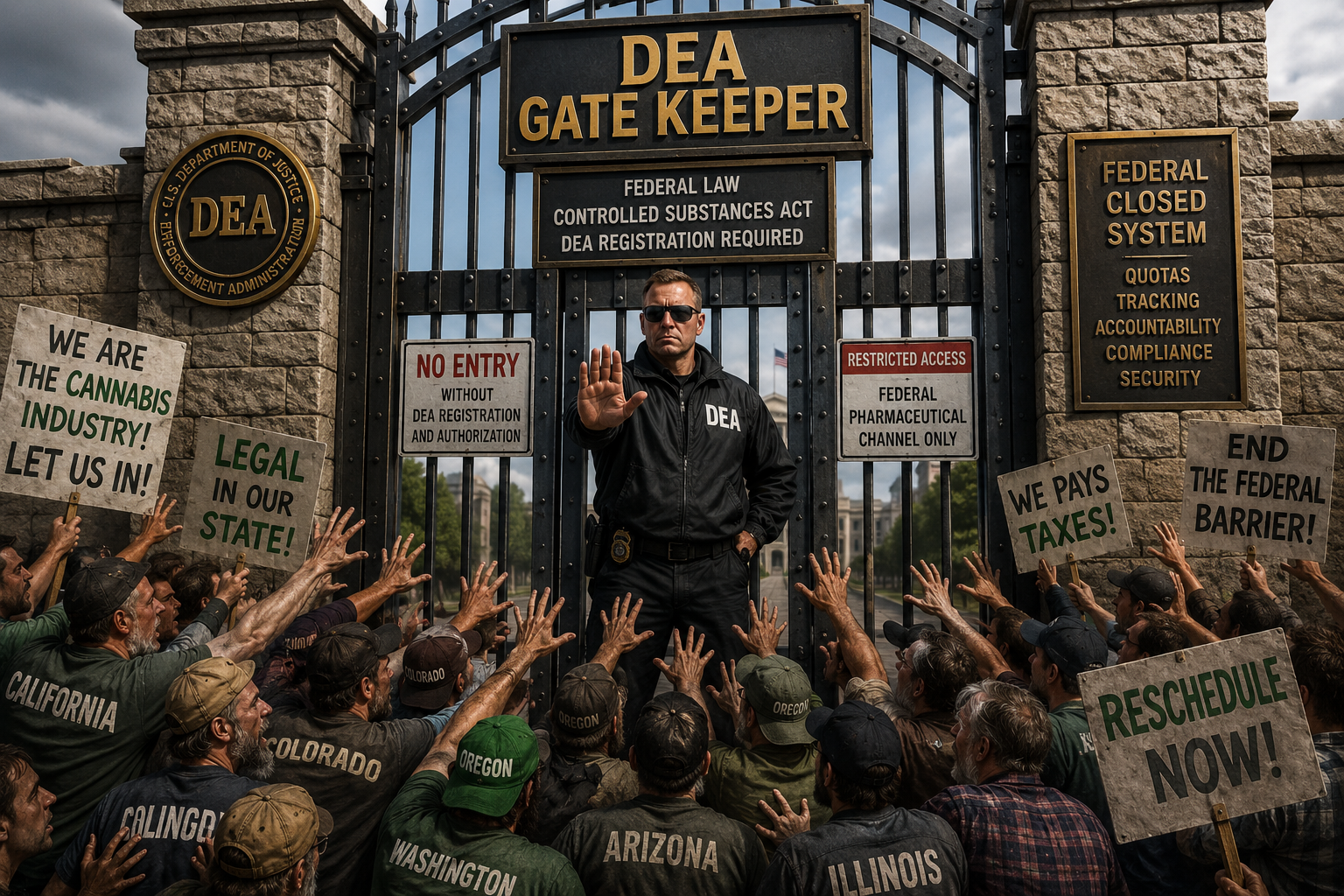
MMJ Stayed Inside the Federal Gate
MMJ BioPharma Labs currently holds an active DEA Schedule I laboratory registration.
MMJ BioPharma Cultivation's DEA bulk active pharmaceutical ingredient (API) manufacturing application remains pending.
MMJ International Holdings has also advanced two FDA Investigational New Drug applications tied to cannabinoid therapies for Huntington's disease and multiple sclerosis.
Rather than pursuing consumer-market cannabinoid sales, MMJ spent years operating within the FDA-and-DEA-controlled pharmaceutical lane - a slower, more expensive pathway requiring:
clinical trial infrastructure
controlled-substance compliance
manufacturing validation
chemistry and stability data
federal oversight
Why This Matters Now
The issue is surfacing at the exact moment federal courts are reviewing multiple cannabis-related disputes involving:
CMS cannabinoid healthcare access
marijuana rescheduling
DEA registration standards
Administrative Procedure Act challenges
Meanwhile, the CMS Substance Access Beneficiary Engagement Incentive (BEI) program is allowing participating healthcare organizations to furnish hemp-derived cannabinoid products inside Medicare-connected care systems without traditional FDA drug approval standards.
Critics argue the federal government is now operating under two different scientific systems:
One:
FDA clinical trials, DEA oversight, pharmaceutical manufacturing controls.
The other:
Healthcare-channel cannabinoid access before full scientific validation.
The Federal "Closed System" Is Becoming Important Again
Under the Controlled Substances Act, DEA operates what is known as a:
"closed system of distribution"
requiring registered handling, quota controls, and full accountability throughout the controlled-substance supply chain.
That system historically governed pharmaceutical cannabinoid research and manufacturing.
MMJ built its business within that system from the beginning.
Many state-market operators did not.
Now DEA's own registration framework appears to be asking regulators to look backward before deciding who moves forward.
The Core Question Facing Regulators
As federal cannabis policy evolves, courts and regulators are increasingly confronting a difficult question:
Which companies operated within the federal pharmaceutical framework from the start -
and which companies built their businesses outside it?
For MMJ International Holdings, the answer is already documented in:
FDA IND filings
DEA registration records
pharmaceutical manufacturing infrastructure
and clinical development programs already operating inside the federal system.
About MMJ International Holdings
MMJ International Holdings is a pharmaceutical cannabinoid development company advancing FDA-and-DEA-compliant therapies for Huntington's disease and multiple sclerosis through clinical-trial pathways, analytical testing infrastructure, and pharmaceutical-grade cannabinoid manufacturing initiatives in the United States.
Madison Hisey
203-231-8583
SOURCE: MMJ International Holdings
View the original press release on ACCESS Newswire