PEREIRA/CALI, Colombia, Aug 11 (Reuters) - Rescue crews dug through mountains of shattered concrete in western Colombia on Tuesday, racing to find survivors after a powerful earthquake killed more than 250 people, according to estimates from local authorities.
Families waited beside the rubble for signs of life.
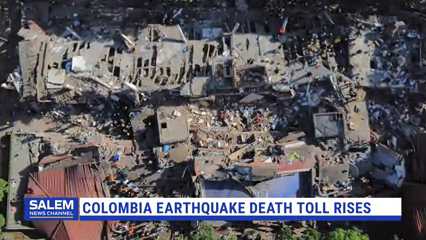
The 7.4-magnitude earthquake, the most powerful to strike the South American country in decades, tore through Colombia's coffee-growing heartland early on Monday, leaving apartment blocks, homes, schools and health centers cracked, leaning or flattened.
Nearly 100 aftershocks were registered as of Tuesday morning.
In the worst-hit cities, rescuers worked through the night with cranes, excavators and, at times, their bare hands, cutting through twisted steel and passing buckets of debris in desperate searches for those still trapped.
Newly inaugurated President Abelardo De La Espriella said he had decreed a three-month economic relief measure for people in the coffee-growing region of Risaralda, speaking from its capital Pereira.
"It broke my heart going through the city center and seeing all these businesses destroyed," he said, adding he hoped the measures would be "a breath of air in the middle of this tragedy."
Separate reports from affected cities put the death toll at 254 on Tuesday morning, with 101 people killed in Pereira and 95 in Cali, the country's third-biggest city.
The United Nations humanitarian office OCHA estimated 5,000 homes were damaged, while dozens of buildings collapsed and hundreds of residences were destroyed, OCHA said.
In Cali, residents gathered in the streets after parts of homes and apartment blocks gave way. Families cooked outside, salvaged what they could and braced for another day away from home. Several of the top floors of one of the city's hospitals — some dedicated to pediatric care — collapsed, leaving some patients trapped and 600 others tended to on a street strewn with rubble, Irne Torres Castro, the hospital's director, told Caracol television.
On Tuesday morning, lines of dump trucks brimming with rubble were heading to Cali's dump, amid heavy traffic after the mayor lifted normal traffic restrictions following the disaster. Many traffic lights remained out as rescuers heaved rubble under 30-degree Celsius (86-degree Fahrenheit) heat.
Cali's public health secretary German Escobar said the city's morgue was full and authorities were bringing more bodies off the streets.
Colombian social media influencer Jose Gallego had just arrived at Pereira airport and was recording live video when the earthquake struck, capturing footage of violent shaking as he crouched under a table and parts of the ceiling fell.
"There were people injured, bleeding, screaming and trying to reach their families but there wasn't any signal," he said. "I crossed the city on foot; it took two hours and the scenes were devastating."
Whole sections of residential neighborhoods were reduced to broken slabs of concrete and exposed rooms. Residents and volunteers formed human chains, while others stood silently nearby, listening for tapping sounds or cries from below.
"They've already pulled several people out, some alive and some dead. I still can't believe it — yesterday at this same time I said hello to them, and today they're gone," said Fernanda Gaviria, 33, speaking from a grocery shop opposite a collapsed building.
Gaviria said she spent the night sleeping in a park after her own apartment building was badly damaged.
The earthquake also knocked out vital infrastructure. Civil aviation authorities closed six airports — Quibdo, Pereira, Manizales, Armenia, Cartago and Buenaventura — due to damage, while dozens of roads were reported to be affected.
Electricity, water, healthcare and phone service remained disrupted in several areas, especially in Choco near the epicenter, complicating rescue efforts and aid delivery.
The U.S. said it had allocated $15.5 million for emergency shelter, food, protection and damage assessments, while the Inter-American Development Bank said it had made $50 million immediately available for reconstruction support if requested.
The U.N.'s Colombia resident coordinator Maria Jose Torres said the U.N. was working to increase its ground presence in the coffee-growing region and that its institutions had not been affected by the country's recent change of government.
With communications still patchy in some of the worst-hit areas, officials said the full extent of the damage and the final death toll could take days to establish.











 5:00PM - 7:00PM
 8:00PM - 10:00PM
 10:00PM - 12:00AM
 12:00AM - 3:00AMThe Mike Gallagher Show1-800-655-MIKE
 3:00AM - 5:00AMThe Hugh Hewitt Show800-520-1234